
How AI Is Transforming the Bike Rental Experience at WavyGo
25 Oct 2026
How AI Is Transforming the Bike Rental Experience at WavyGo
Renting a bike should be simple. You choose where you need it, decide how long you want to use it, compare the available options, and make your booking. But in practice, finding the right two-wheeler at the right price can take longer than expected.
Someone visiting a new city may not know which rental shops are nearby. A student might be looking for an affordable scooter for a few days, while a traveller may want a motorcycle for exploring the surrounding area. Each person has a different requirement, and finding the right option should not mean spending hours searching.
This is where artificial intelligence (AI) could make a difference.
AI is changing how digital platforms understand customer needs, organise information, and provide assistance. For bike rental platforms like WavyGo, it creates opportunities to make the rental journey more convenient—from discovering suitable bikes to getting answers to common questions.
Let's look at how AI could improve the bike rental experience and what this could mean for the future of mobility.
1. Smarter Bike Search
Most people don't think in terms of search filters. They think about what they need.
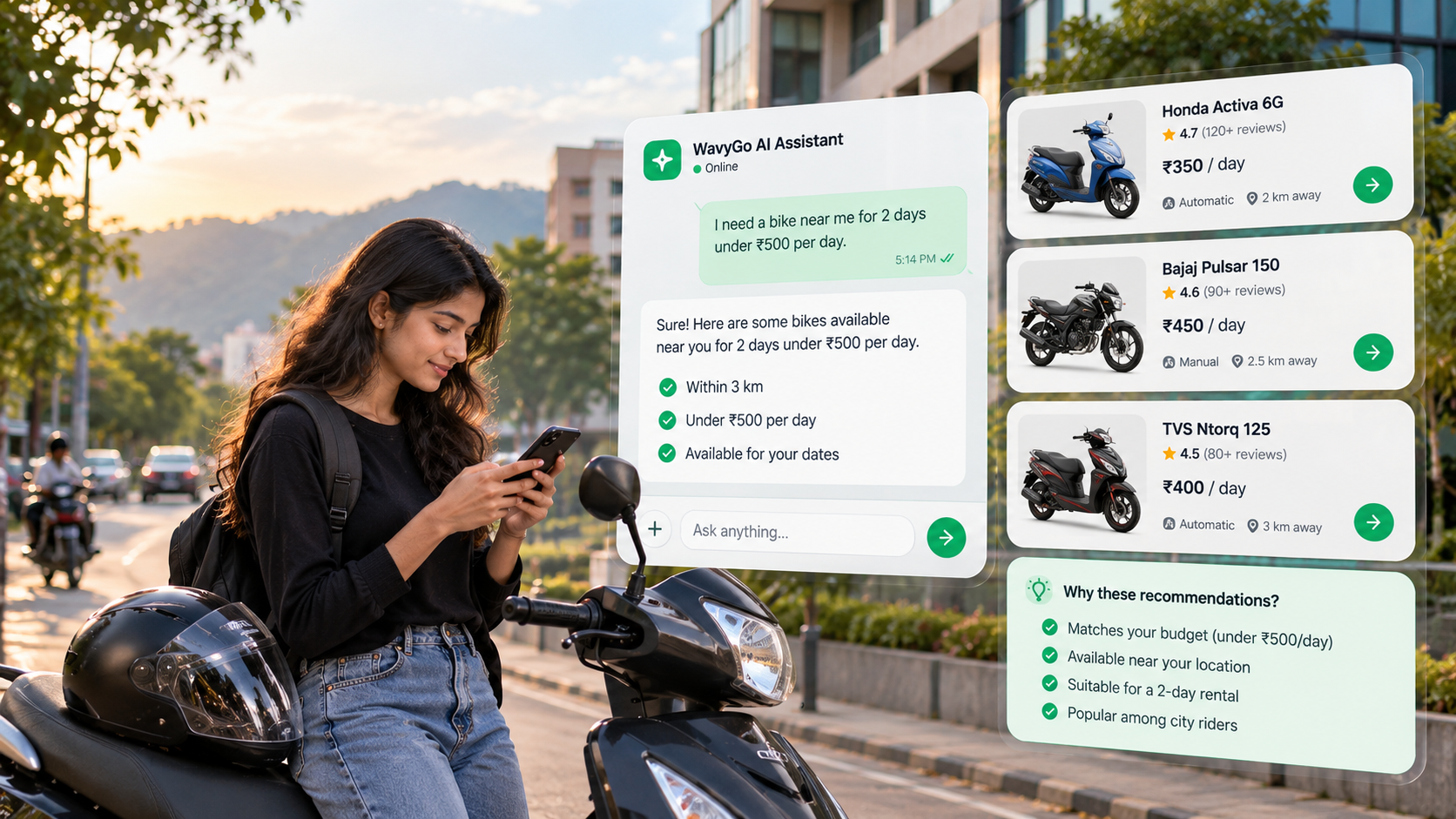
A customer might say, "I need a scooter near me for two days, and my budget is ₹500 per day." Another might search for a bike for a weekend trip or an affordable vehicle for daily commuting.
A conventional search usually requires customers to select their location, rental dates, vehicle category, and budget separately. An AI-assisted search could make this process more natural by understanding a request written in everyday language.
For example, a future WavyGo search assistant could interpret a request and identify four important details:
- Location: Where the customer wants to pick up the bike.
- Duration: How long the vehicle is needed.
- Budget: The customer's preferred daily or total rental cost.
- Vehicle preference: Whether the customer wants a scooter, motorcycle, or another available option.
The platform could then use those details to help the customer explore matching vehicles, subject to actual inventory and availability.
What if the exact match isn't available? Instead of leaving the customer with no useful direction, an intelligent search experience could suggest alternatives within the customer's budget or at a nearby pickup location.
The idea is straightforward: customers should spend less time figuring out how to search and more time comparing options that genuinely meet their needs.
2. AI-Powered Customer Assistance
First-time renters often have questions before they feel comfortable making a booking.
Which documents are required? How does the booking process work? What should be checked before collecting the bike? What happens if a customer needs help during the rental period?
These questions are normal, but finding the correct answer across multiple pages or messages can be frustrating.
An AI-powered assistant could help customers find answers through a simple conversation. Instead of navigating several sections of a website, a customer could ask a question in their own words and receive a response based on WavyGo's verified policies and service information.
For example, someone unfamiliar with bike rentals could ask how to get started. The assistant could explain the general booking steps and guide them towards viewing available vehicles.
For this to work reliably, the assistant would need access to accurate, regularly maintained information. It should not invent rental prices, promise availability without checking the inventory, or provide policies that WavyGo has not approved.
AI assistance should also have clear limits. Questions involving payment disputes, account-specific problems, safety concerns, or unusual booking situations may require a human support representative. Customers should always have a clear way to request that help.
The purpose isn't to remove the human element from customer service. It's to make routine information easier to access while allowing people to handle situations that need personal attention.
3. Personalized Bike Recommendations
The best rental bike depends on what a person plans to do with it.
A student travelling around a city may prioritise affordability and ease of use. A tourist exploring nearby attractions may care more about comfort, the type of roads, and the duration of the ride. Someone booking for several days may want to compare the total rental cost rather than looking only at the daily price.
AI could help bring these preferences together.
By considering information such as the customer's budget, rental duration, selected location, intended use, and stated vehicle preferences, a recommendation system could highlight options worth considering.
For example, a customer looking for an economical two-day rental might see suitable scooters first. Someone who specifically prefers a motorcycle could receive recommendations from the available motorcycle inventory instead.
Good recommendations should also explain themselves. If a vehicle appears in the results because it fits the selected budget, is available for the requested dates, or is close to the pickup location, the platform should make those reasons clear.
There is an important distinction between a useful recommendation and a forced choice. Customers should remain free to browse other vehicles, compare prices, read the available details, and make their own decisions.
Personalization should make the choice easier, not restrict it.
4. Faster Answers to Common Rental Questions
A customer who is ready to book may still hesitate if an important detail is unclear.
They might want to confirm the rental duration, understand the listed charges, check the required documents, or learn about pickup and return arrangements. If these answers are difficult to find, even an interested customer may postpone the booking.
An AI support assistant could help address routine questions at any time by drawing on approved information about the rental process.
It could guide customers towards relevant policies, explain the next booking step, and help them identify which details they should confirm before paying.
There is also an opportunity to make support more organised. When a question needs human assistance, an AI assistant could collect the relevant details—with appropriate privacy safeguards—so the customer does not have to explain the same issue repeatedly.
However, speed alone isn't enough. An incorrect answer about a fee, cancellation rule, or booking status can create more frustration than a delayed response.
For WavyGo, the long-term opportunity is to combine quicker assistance with accurate information, clear escalation to human support, and a consistent customer experience.
5. Making the Booking Journey Simpler
A bike rental experience involves more than finding a vehicle. Customers need to understand the price, check availability, review the rental conditions, complete the booking, and know what to do at pickup and return.
AI could help connect these steps into a more straightforward journey.
Imagine a customer planning a short visit to a city. They enter their preferred location, explain how long they need a vehicle, and mention their approximate budget. An AI-assisted experience could help organise those requirements, highlight relevant available options, and direct the customer to the appropriate booking details.
Rather than making assumptions, the system should ask follow-up questions whenever important information is missing. It should also clearly distinguish estimated costs from confirmed charges and suggested vehicles from confirmed bookings.
This matters because convenience is not simply about reducing clicks. It's about helping people understand what they are choosing and what happens next.
A well-designed rental platform should make the important details easy to find before the customer commits.
6. How AI Could Help Bike Rental Partners
The benefits of AI may extend beyond customers. Rental partners also deal with everyday tasks that take time away from serving riders.
Depending on the systems available and the quality of their data, AI tools could eventually help rental businesses organise information, respond to routine enquiries, and understand patterns in customer demand.
For example, a rental partner might benefit from clearer insights into which vehicle categories receive more enquiries during certain periods. A well-designed system could help summarise booking trends or flag inventory information that needs updating.
AI-assisted communication could also help partners prepare consistent answers to common questions about their services.
These tools would need to work alongside reliable inventory and booking records. An AI system cannot accurately recommend a vehicle if its availability information is outdated, and it should not make operational decisions without appropriate checks.
For WavyGo, this creates a potential opportunity to support both sides of the marketplace: helping customers discover suitable vehicles while helping rental partners manage their digital presence more effectively.
7. Using AI Responsibly in Mobility
AI can make digital services more convenient, but adding AI to a platform is not automatically an improvement. The quality of the experience depends on how the technology is designed and used.
For a bike rental service, a few principles are especially important.
Accurate information comes first. Recommendations should rely on reliable vehicle details, pricing, and availability. Customers should be directed to confirm the final booking information before making a payment.
Customer privacy matters. Location details, contact information, and booking history should be handled according to appropriate privacy and security practices. Personal information should not be collected simply because a system can collect it.
Customers should remain in control. AI-generated suggestions should be presented as suggestions. Riders should be able to compare alternatives and make their own choices.
Human help should remain accessible. An automated assistant should recognise when a question falls outside its capabilities and offer an appropriate route to human support.
The experience should improve through testing. Before introducing an AI feature, a platform should evaluate whether it provides accurate answers, reduces confusion, and genuinely helps customers complete tasks.
These principles are particularly relevant to mobility services, where unclear information can affect a customer's time, money, and travel plans.
8. The Future of AI-Powered Bike Rentals at WavyGo
At WavyGo, our focus is on making bike rentals more accessible by connecting customers with rental partners through a digital platform.
AI presents an opportunity to build on that idea. Over time, AI-assisted search, relevant vehicle recommendations, and more accessible customer assistance could help make the rental journey easier to navigate.
The possibilities extend beyond the initial search. Customer feedback and carefully analysed service patterns could help identify where people encounter difficulties, which information is missing, and where the booking journey could be improved.
For rental partners, better digital tools could help make inventory information clearer and customer enquiries easier to manage.
These are development opportunities rather than a claim that every AI capability is already available on WavyGo. Each feature would need to be developed, tested, and evaluated against actual customer and partner needs before being introduced.
The objective is not to use AI simply because it is a popular technology. It is to identify practical problems and determine where intelligent tools can solve them reliably.
Frequently Asked Questions
How can AI improve the bike rental experience?
AI could help customers search using everyday language, discover relevant vehicles, get answers to common questions, and navigate the booking process more easily. The results depend on the quality of the underlying data and the features a platform has implemented.
Can AI recommend the right bike for my trip?
An AI-based recommendation system could consider your budget, rental duration, location, vehicle preference, and intended use. Its suggestions would still need to be checked against actual inventory, availability, and rental conditions.
Can AI help first-time bike renters?
Yes. An appropriately designed AI assistant could explain the booking process, direct customers to document requirements, and answer routine questions using verified service information.
Will AI replace customer support?
It doesn't have to. AI can handle routine enquiries, while human support remains important for complex issues, payment disputes, safety concerns, and situations requiring individual judgement.
Does WavyGo currently offer all these AI features?
The features discussed in this article describe potential ways AI could improve the WavyGo experience. They should not be interpreted as confirmation that AI-powered search, personalised recommendations, or an AI support chatbot are currently available on the platform. Customers should refer to WavyGo's actual app and website for its current features and services.
Conclusion
The future of bike rentals will depend on more than simply putting vehicles online. Customers need clear information, suitable options, transparent pricing, and assistance when they need it. Rental partners need practical tools that help them serve customers and manage their businesses.
AI could help bring these parts of the experience together. From understanding natural-language searches to making more relevant recommendations and answering routine questions, it offers several ways to reduce unnecessary effort.
For WavyGo, the priority is to explore these possibilities thoughtfully and focus on features that solve real problems for customers and rental partners.
Technology should make renting a bike feel simpler, not more complicated. And whatever role AI plays in that future, the customer should remain at the centre of the experience.
Ready to explore bike rentals and travel guides with WavyGo? Visit WavyGo to learn more about the platform and its services.
